





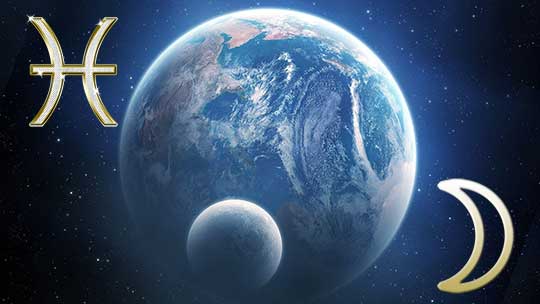
 The Moon: the second most important luminary—often the first for women. The Moon gathers and transforms the energy of other planets, especially the Sun. She is the mistress of instincts and emotions, the planet of moods. A symbol of the feminine principle, conception, and motherhood—as opposed to Venus, which symbolizes sensual love. In a man’s natal chart, the Moon can indicate the first marriage, which inevitably ends.
Intellectual Level: unconscious psychic processes, spiritual components, memory faculties, and stable behavioral characteristics.
Physical Level: hormone production, the gastrointestinal tract, the lymphatic system, organs of vision, digestion and assimilation of food, behavioral reactions. For women, it rules the right side of the body, for men—the left.
Emotional Level: a rich imagination, inner intuition, high sensitivity, changeable moods, capriciousness, lack of decisiveness, well-developed intuition, vulnerability, a tendency toward melancholy, the sphere of emotional-sensuality in the personality.
The Moon in Zodiac Signs:
 Moon in Aries Moon in Aries(March 21 – April 20) |
 Moon in Taurus Moon in Taurus(April 21 – May 21) |
 Moon in Gemini Moon in Gemini(May 22 – June 21) |
 Moon in Cancer Moon in Cancer(June 22 – July 23) |
 Moon in Leo Moon in Leo(July 24 – August 23) |
 Moon in Virgo Moon in Virgo(August 24 – September 23) |
 Moon in Libra Moon in Libra(September 24 – October 23) |
 Moon in Scorpio Moon in Scorpio(October 24 – November 22) |
 Moon in Sagittarius Moon in Sagittarius(November 23 – December 21) |
 Moon in Capricorn Moon in Capricorn(December 22 – January 20) |
 Moon in Aquarius Moon in Aquarius(January 21 – February 19) |
 Moon in Pisces Moon in Pisces(February 20 – March 20) |
The Moon is the ruler of Cancer. Its exaltation is considered to be Taurus. Capricorn is the sign of its fall, and Scorpio is the sign of its detriment (exile).
The Moon is closer to the Earth than any other member of the Solar System; it moves around Earth in a very complex orbit, so its influence is not only great, but also multifaceted. There are several methods for accounting for this influence; we will consider them as needed, but for now it is important to note that lunar phases are of great importance in astrology.
The phases of the Moon are: New Moon (First Quarter), Second Quarter, Full Moon (Third Quarter), and Last Quarter. Each phase lasts about a week; all four make up a lunar month. The phases are given in ephemerides and also in regular calendars. They can also be determined visually, by looking at the cosmogram. The conjunction of the Sun and Moon is the New Moon (more precisely, its beginning, the point of transition from the Last Quarter to the New Moon phase). The left square (Sun/Moon) marks the beginning of the Second Quarter, the opposition of both luminaries corresponds to the Full Moon, and the right square indicates the end of the Third and the beginning of the Last Quarter. The general rule is that the waxing Moon (moving from New Moon to Full Moon) is favorable, while the waning Moon is considered unfavorable.
A favorable Moon (in its own sign, exaltation, or with good aspects) indicates a predominance of spiritual interests over material ones, affability, sociability, love of home, and a maternal instinct.
An unfavorable Moon brings moodiness, inconsistency, laziness, and unreliability. In addition, it can cause diseases of the right eye in women and the left in men, issues with the left side of the body, stomach, and chest. The unfavorable Moon also plays a major role in the development of nervous and mental disorders: any—even favorable—aspect with Mercury and Uranus leads the astrologer to suspect at least a nervous disposition in the native. The conjunction of Saturn and the Moon, especially the right (waning) one, can also indicate serious illnesses or other fateful circumstances in life.
Lunations—conjunctions or oppositions of the Moon and Sun—are also important. People born at the New Moon (Sun–Moon conjunction) or Full Moon (Sun–Moon opposition) generally experience more twists of fate in life than those born on more “neutral” lunar days. However, they often also achieve more.
The waxing Moon phase (1st–15th lunar day) is considered favorable for birth and for any new beginnings. The Russian astrologer V. Zapryagaev, in particular, noted: “Before performing a surgical operation, pay attention to the position of the Moon and Mars: the Moon should not be in the sign that corresponds to the diseased part of the body, and Mars should not cast a hostile ray onto it.”
Nevertheless, people born under a waning Moon, though more prone to illness and less fortunate, may find their luck increase during the waning Moon period.
The numbers associated with the Moon are two and seven. Monday is the day of the week corresponding to the Moon—a connection found in both Germanic and Romance languages.
The color of the Moon is considered to be white (silvery). Its metal is silver. Its stones are quartz, pearl, and coral. Among plants: palms and various types of lilies; among animals: the frog, owl, and cat. ✓
Share with your friends. +5 to Karma

Articles from the category:
-
 Libra – characteristic of the sign
Libra stones Sun in Libra Children's horoscope. Libra is a child. Pisces and Libra - sign compatibility Libra and Aquarius - sign... -
 Moon in Libra
When the Moon is in Libra, it finds much in common with the sign's ruler, Venus. The Moon acquires lightness and airy grace, both inner and outer beauty, and delights...
Popular articles:
-
 Neptune – MC (Midheaven) Conjunction – The Power of Dreams
The Midheaven on the cusp of the Tenth House shows the chart owner in which sphere they can successfully and productively fulfill their calling. This is not only the... -
 Moon – MC (Midheaven) Square – The Winding Path of Intuition
A square to the Meridian of the Midheaven creates incredible tension in a person’s soul, especially when they are unable to fulfill what they have planned for a long... -
How to Fill Out and Calculate a Natal Chart: Step-by-Step Instructions
Filling Out the Natal Chart Form If you came to this page from search, these instructions refer to this natal chart. 1. Fill in the Name field. This field may be... -
 Method of Natal Chart (Horoscope) Analysis
The natal chart (horoscope) is a person’s astrological passport. Interpreting it can help uncover the causes of setbacks, adjust the development of one’s life...
Comments: