Aspects give a unique shade to the energy of the planets and help reveal the nuances of their influence on the native’s fate and character. They determine the dynamics of soul growth, patterns of behavior, and responses to various events. These interconnections can sometimes alter the meaning of both the celestial bodies themselves and the signs they inhabit. Without understanding aspects, it is impossible to discern the pattern of destiny in the natal chart, let alone consciously work through challenging areas in order to avoid danger.
There are two types of aspects: harmonious aspects, which reveal talents and opportunities for wealth and recognition – serving as a karmic reward – and challenging ones, which require stabilization and the overcoming of obstacles. The former provide energy for the free expression of talents, self-confidence, and good health, while the latter attract stressful situations for learning, indicating where energy is blocked. A person who has honorably passed the tests of tense aspects is often more fortunate than someone whose chart contains only positive configurations.
The analysis of the natal cosmogram (the birth chart) is the study of the influence that the planets in the native’s horoscope have on their character and destiny. The influence of natal planets on the native’s role and fate is determined, firstly, by their position in a sign or House, regardless of the house calculation system, and secondly, by their mutual arrangement – that is, their aspects.
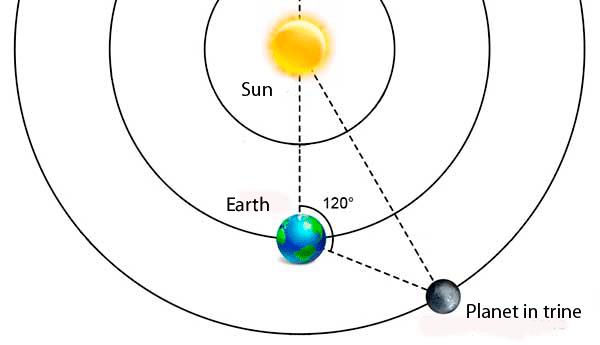 An aspect is an arc connecting one planet (or point) to another, measured along the ecliptic and expressed in degrees. Each aspect has its own name and is represented by a specific symbol. Aspects are named after the geometric figures inscribed within a circle and formed by the chords of the corresponding arcs – such as a hexagon, square, or triangle.
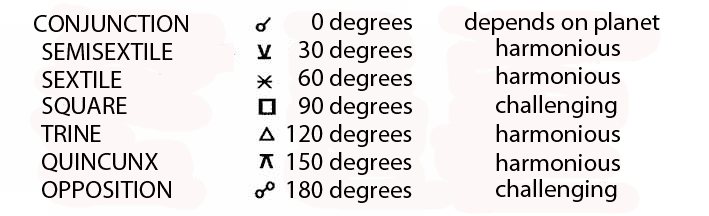
Harmonious Major Aspects
Since the time of Ptolemy, it has been customary to distinguish five main, or major, aspects, which are represented in the chart by a solid line. These include: conjunction, trine, sextile, square, and opposition. An abundance of positive connections between planets makes life easier, but can also lead to such relaxation that creativity is abandoned altogether. Negative, black, or blue lines stimulate the native to fight for happiness, but if they dominate over the favorable aspects, this can lead a person toward despair and despondency. Harmonious aspects are marked in green. They represent innate talents, beauty, charm, positive personal qualities, and good fortune.
There are three major pillars of luck in any horoscope:
Conjunction
When planets are positioned next to each other within a 7-degree orb and are outlined by a blue or red arc, they enhance each other’s qualities in a positive way, helping the native achieve success in the areas of life governed by the sign and House involved. The primary gift of this aspect is the ability to concentrate and work hard. Compatible planets (for example, Mars and Jupiter) bring immediate results, while incompatible ones (such as Saturn and Venus) create tension (the arc will be blue) and signify the need to overcome difficulties in order to achieve a spectacular victory. This requires activity and total dedication to developing the qualities of the planets involved.
Trine
The trine is a 120° aspect that connects points in the horoscope belonging to the same element, bringing ease of achievement and joy in self-expression. In ancient times, it was considered a challenging aspect, as it could lead to laziness and egocentrism if there was a lack of spiritual development. It is a sign of fortunate opportunities and creative talent, but the native may still fail to realize their potential if they simply drift through life. On the practical level, a trine harmonizes two areas of life; for example, a trine between the Second and Seventh Houses may bring financial gain through marriage or business partnership.
Sextile
The 60° aspect is not permanent in its influence, but gently helps the energies of the planets to “befriend” one another and attracts a stream of fortunate events and opportunities for creative expression. This is a potential that needs to be refined through practice into a powerful tool for success. The sextile facilitates interaction between Houses and the matters they govern.
Eastern astrologers consider a natal chart covered with red lines to be a challenging test. Without personal development, talents may remain hidden or go unrecognized.
Challenging Major Aspects
These aspects are shown as red lines and are not fatalistic; rather, they represent not some malevolent fate but a challenge from circumstances and the prospect of growth. Often, people with many squares in their chart achieve more than those with trines and are better able to withstand adversity.
Square
The 90° aspect blocks or disrupts plans and creates obstacles with the purpose of prompting creativity and resourcefulness. The function of one planet tends to suppress or undermine the other, which calls for harmonization and consistent action. At a lower level of consciousness, it can bring blows of fate and unfortunate events; at a higher level, it produces talent forged through trials and hard work on oneself. On the practical level, it manifests as competition and challenging situations that require overcoming inner complexes and rigidity. Refusing to face stress can hold the native back both spiritually and materially.
Opposition
The opposition is a 180° aspect, representing the conflict of planetary functions with a shifting dominant influence. This creates an internal split in consciousness that requires the integration of opposites into a unified system. It often brings situations of choice, where either cooperation and acceptance or a complete break is necessary.
Minor Aspects
These aspects are shown as dashed lines, are weaker than major aspects, and do not typically influence external circumstances. Rather, they reflect personal characteristics of the native.
Semisextile
This aspect joins planets at a 30° angle and is activated periodically, offering protection in difficult situations as a reward for demonstrated nobility, purity, and care for nature. It brings small strokes of luck and returns benefits through group efforts and little miracles. The aspect manifests most strongly when connected to the cusp of a sign. An afflicted semisextile can distort a person’s worldview and cause them to act against both human and cosmic harmony (as seen with black magicians or those who harm others).
Quincunx
The quincunx is a continuously active aspect at a 150° angle, provoking recurring situations that require review and change. It can be favorable if the native experiences repeating positive events, as this is a result of good karma. However, malefic planets can attract the return of painful and stressful conditions until the person learns to detach from negativity. Often, these repetitions are connected to health issues that are influenced by emotional responses to events.
It is important to remember that a person with a low level of consciousness and spirituality typically experiences only one or two major aspects, but as awareness, creativity, and intellectual development grow, the native can begin to orchestrate the network of planetary relationships in the horoscope, creating a unique symphony of destiny.
Orb
An orb is the allowable range of degrees within which two planets or points can form an aspect in the natal chart. For example, if two planets are almost 90° apart (the square aspect), an orb of 1–8° can still be considered a square, though the influence is strongest when they are exactly 90° apart with an orb of zero. The size of the orb may vary depending on the type of aspect and the astrologer’s preferences. The smaller the orb value (orb = 0 means an exact aspect), the stronger the influence of that aspect.
Cazimi and Combust Planets
An aspect is rarely absolutely exact; it is clear that the more exact the aspect, the stronger its influence. However, there are cases where excessive exactness can be detrimental. “Nothing in excess,” as the ancients used to say. If a planet comes closer than 4° to the Sun, it is called “combust.” Such a planet is considered to be “burnt out” and ceases to function outwardly: all the energy of its conjunction with the Sun turns inward. A person with a combust planet may act or feel emotions only in their imagination, rarely bringing intentions into reality. This kind of “stagnation” of intentions and emotions can lead to nervous or even physical illnesses.
If the planet draws even closer to the Sun (within half a degree, or 0°30′), the picture changes again: the planet is then said to be “in the heart of the Sun” (cazimi). In this case, the planet and the Sun form a single entity, so it would be more accurate to say that the native has not just the Sun, but a new composite figure in the chart – Sun-Mars, Sun-Mercury, etc. At the same time, the planet loses the ability to express its qualities except in an “explosive” way, like a bursting abscess: for example, Sun-Mars often gives rise to tumors, while Sun-Mercury can indicate dangerous accidents (such a Mercury might have belonged to Bulgakov’s Misha Berlioz – otherwise, it’s hard to explain why a seemingly harmless “Mercury in the Second House” led him under the wheels of a tram).
An aspect can also be multiple, expressing relationships not only between individual planets but also between groups of planets. Planets that do not participate in single aspects may be involved in multiple ones. Aspects can be double, triple, and so on. ✓
 |
Aspects of the Sun |
| ASPECTS | PLANETS |
| CONJUNCTION
|
Sun moon |
| Sun – Mercury | |
| Sun – Venus | |
| Sun – Mars | |
| Sun – Jupiter | |
| Sun – Saturn | |
| Sun – Uranus | |
| Sun – Neptune | |
| Sun – Pluto |

| ASPECTS | PLANETS |
| SEXTILE
|
Sun moon |
| Sun – Mars | |
| Sun – Jupiter | |
| Sun – Saturn | |
| Sun – Neptune | |
| Sun – Pluto | |
| Sun – Uranus |

| ASPECTS | PLANETS |
| SQUARE
|
Sun moon |
| Sun – Jupiter | |
| Sun – Mars | |
| Sun – Saturn | |
| Sun – Neptune | |
| Sun – Uranus | |
| Sun – Pluto |

| ASPECTS | PLANETS |
| TRINE
|
Sun moon |
| Sun – Mars | |
| Sun – Jupiter | |
| Sun – Saturn | |
| Sun – Uranus | |
| Sun – Pluto |

| ASPECTS | PLANETS |
| OPPOSITION
|
Sun moon |
| Sun – Mars | |
| Sun – Jupiter | |
| Sun – Saturn | |
| Sun – Uranus | |
| Sun – Pluto | |
| Sun – Neptune |

 |
Aspects of the Moon |
| ASPECTS | PLANETS |
| CONJUNCTION
|
Moon – Mercury |
| Moon – Jupiter | |
| Moon – Venus | |
| Moon – Mars | |
| Moon – Saturn | |
| Moon – Uranus | |
| Moon – Neptune | |
| Moon – Pluto |
| ASPECTS | PLANETS |
| SEXTILE
|
Moon – Mercury |
| Moon – Venus | |
| Moon – Mars | |
| Moon – Jupiter | |
| Moon – Saturn | |
| Moon – Uranus | |
| Moon – Neptune | |
| Moon – Pluto |
| ASPECTS | PLANETS |
| SQUARE
|
Moon – Mercury |
| Moon – Venus | |
| Moon – Mars | |
| Moon – Jupiter | |
| Moon – Saturn | |
| Moon – Pluto | |
| Moon – Neptune | |
| Moon – Uranus |
| ASPECTS | PLANETS |
| TRINE
|
Moon – Mercury |
| Moon – Venus | |
| Moon – Mars | |
| Moon – Jupiter | |
| Moon – Saturn | |
| Moon – Neptune | |
| Moon – Uranus | |
| Moon – Pluto |
| ASPECTS | PLANETS |
| OPPOSITION
|
Moon – Mercury |
| Moon – Jupiter | |
| Moon – Mars | |
| Moon – Venus | |
| Moon – Saturn | |
| Moon – Neptune | |
| Moon – Uranus | |
| Moon – Pluto |
Share with your friends. +5 to Karma

Articles from the category:
-
 Neptune – MC (Midheaven) Conjunction – The Power of Dreams
The Midheaven on the cusp of the Tenth House shows the chart owner in which sphere they can successfully and productively fulfill their calling. This is not only the... -
 Moon – MC (Midheaven) Square – The Winding Path of Intuition
A square to the Meridian of the Midheaven creates incredible tension in a person’s soul, especially when they are unable to fulfill what they have planned for a long... -
 Pluto – Lilith Conjunction – Power as Violence
When Lilith merges with a planet into one whole, it does not give its own energy, but feeds like a vampire on the negative manifestations of the other participant in the... -
 Venus – Lilith Square – Criminal Passions
A tense aspect with the Black Moon, or Lilith, interferes with the proper expression of another planet’s energies. Venus is responsible for the sense of beauty, style,... -
 Stelliums in the Natal Chart
Three or more planets within a conjunction orb of about 6° in one zodiac sign - within a span of about 20°, or straddling the cusp of two signs - are called a...
Popular articles:
-
Neptune – MC (Midheaven) Conjunction – The Power of Dreams
The Midheaven on the cusp of the Tenth House shows the chart owner in which sphere they can successfully and productively fulfill their calling. This is not only the... -
Moon – MC (Midheaven) Square – The Winding Path of Intuition
A square to the Meridian of the Midheaven creates incredible tension in a person’s soul, especially when they are unable to fulfill what they have planned for a long... -
How to Fill Out and Calculate a Natal Chart: Step-by-Step Instructions
Filling Out the Natal Chart Form If you came to this page from search, these instructions refer to this natal chart. 1. Fill in the Name field. This field may be... -
 Method of Natal Chart (Horoscope) Analysis
The natal chart (horoscope) is a person’s astrological passport. Interpreting it can help uncover the causes of setbacks, adjust the development of one’s life...
Comments: